

I think Dominic Housatonic developed into a mushroom cloud as it progressed (past the interval captured by the slowmo).


I think Dominic Housatonic developed into a mushroom cloud as it progressed (past the interval captured by the slowmo).


The atomic bombings of Hiroshima and Nagasaki made mushroom clouds.
In the Baker test at Bikini Atoll, the bomb was underwater, dimming the initial flash and making initial transient effects more visible.


For example, I think Yudkowsky looks worse now than he did before. Correct me if I’m wrong, but I think the worst we knew prior to fhis was that the Singularity Institute had accepted money from a foundation that Epstein controlled. On 19 October 2016, Epstein’s Wikipedia bio gets to sex crimes in sentence three. And the “Solicitation of prostitution” section includes this:
In June 2008, after pleading guilty to a single state charge of soliciting prostitution from girls as young as 14,[27] Epstein began serving an 18-month sentence. He served 13 months, and upon release became a registered sex offender.[3][28] There is widespread controversy and suspicion that Epstein got off lightly.[29]
At this point, I don’t care if John Brockman dismissed Epstein’s crimes as an overblown peccadillo when he introduced you.


Reading the e-mails involving Brockman really creates the impression that he worked diligently to launder Epstein’s reputation. An editor at Scientific American I noticed when looking up where Carl Zimmer was mentioned seemed to be doing the same thing… One thing people might be missing in the hubbub now is just how much “reputation management”—i.e., enabling— was happening after his conviction. A lot of money went into that, and he had a lot of willing co-conspiritors. Look at what filtered down to his Wikipedia page by the beginning of 2011, which is downstream of how the media covered his trial and the sweetheart deal that Avila made to betray the victims… It’s all philanthropy this and generosity that, until a “Solicitation of prostitution” section that makes it sound like he maybe slept with a 17-year-old who claimed to be 18… And look, he only had to serve 18 months! He can’t have done anything that bad, could he?
There’s a tier of people who should have goddamn known better and whose actions were, in ways that only become more clear with time, evil. And the uncomfortable truth is that evil won, not just in that the victims never saw justice in a court of law, but in that the cover-up worked. The Avilas and the Brockmans did their job, and did it well. The researchers who pursued Epstein for huge grants and actively lifted Epstein up (Nowak and co.), hoo boy are they culpable. But the very fact of all that uplifting and enabling means that the people who took one meeting because Brockman said he’d introduce them to a financier who loved science… rushing to blame them all, with the fragmentary record we have, diverts the blame from those most responsible.
Maybe another way to say the above: We’re learning now about a lot of people who should have known better. But we are also learning about the mechanisms by which too many were prevented from knowing better.


ChatGPT is using Grokipedia as a source, and it’s not the only AI tool to do so. Citations to Elon Musk’s AI-generated encyclopedia are starting to appear in answers from Google’s AI Overviews, AI Mode, and Gemini, too. […] When it launched, a bulk of Grokipedia’s articles were direct clones of Wikipedia, though many others reflected racist and transphobic views. For example, articles about Musk conveniently downplays his family wealth and unsavory elements of their past (like neo-Nazi and pro-Apartheid views) and the entry for “gay pornography” falsely linked the material to the worsening of the HIV/AIDS epidemic in the 1980s. The article on US slavery still contains a lengthy section on “ideological justifications,” including the “Shift from Necessary Evil to Positive Good.” […] “Grokipedia feels like a cosplay of credibility,” said Leigh McKenzie, director of online visibility at Semrush. “It might work inside its own bubble, but the idea that Google or OpenAI would treat something like Grokipedia as a serious, default reference layer at scale is bleak.”
https://www.theverge.com/report/870910/ai-chatbots-citing-grokipedia
The entire AI industry is using the Nazi CSAM machine for training data.


We will soon merge with and become hybrids of human consciousness and artificial intelligence ( created by us and therefore of consciousness)


Great to hear from you. I was just up at MIT this week and met with Seth Lloyd (on Wednesday) and Scott Aaronson (on Thursday) on the “Cryptography in Nature” small research conference project. These interactions were fantastic. Both think the topic is wonderful and innovative and has promise. […] I did contact Max Tegmark about a month ago to propse the essay contest approach we discussed. He and his colleagues offered support but did not think that FQX should do it. Reasons they gave were that they saw the topic as too narrow and too technical compared to the essay contests they have been doing. It is possible that the real reason was prudence to avoid FQX, already quite “controversial” via Templeton support to become even more so via Epstein-related sponsorship of prizes. […] Again, I am delighted to have gotten such very string affirmation, input and scientific enthusiasm from both Seth and Scott. You have very brilliantly suggested a profound topical focus area.
—Charles L. Harper Jr., formerly a big wheel at the Templeton foundation


“Friday? We’re meeting at Jeffrey’s Thursday night” —Stuart “consciousness is a series of quantum tubes” Hameroff


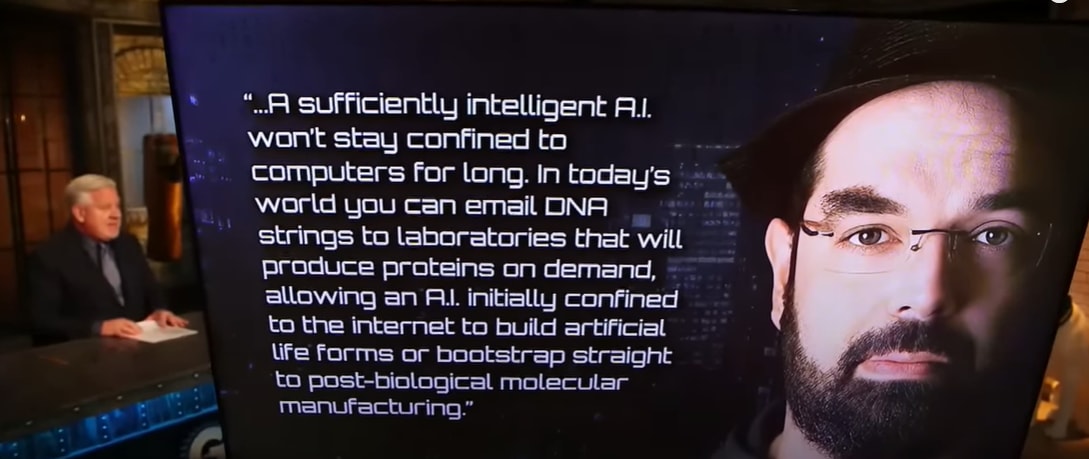
Jeffrey, meet Eliezer!
Nice to hear from you today. Eliezer: you were the highlight of the weekend!


What TF is his notation for Turing machines?


None of these words are in the Star Trek Encyclopedia


I think I read the Foucault book in that series to prep for high-school debate team.


I think that’s more about Wolfram giving a clickbait headline to some dicking around he did in the name of “the ruliad”, a revolutionary conceptual innovation of the Wolfram Physics Project that is best studied using the Wolfram Language, brought to you by Wolfram Research.
The full ruliad—which appears at the foundations of physics, mathematics and much more—is the entangled limit of all possible computations. […] In representing all possible computations, the ruliad—like the “everything machine”—is maximally nondeterministic, so that it in effect includes all possible computational paths.
Unrelated William James quote from 1907:
The more absolutistic philosophers dwell on so high a level of abstraction that they never even try to come down. The absolute mind which they offer us, the mind that makes our universe by thinking it, might, for aught they show us to the contrary, have made any one of a million other universes just as well as this. You can deduce no single actual particular from the notion of it. It is compatible with any state of things whatever being true here below.


Jeff Sharlet (@jeffsharlet.bsky.social):
The college at which I’m employed, which has signed a contract with the AI firm that stole books from 131 colleagues & me, paid a student to write an op-ed for the student paper promoting AI, guided the writing of it, and did not disclose this to the paper. […] the student says while the college coached him to write the oped, he was paid by the AI project, which is connected with the college. The student paper’s position is that the college paid him. And there’s no question that college attempted to place a pro-AI op-ed.


Mateusz Fafinski (@calthalas.bsky.social):
Happy to see that there is no need to worry about the historical accuracy of new 1776 AI slop because it happens in the mystical land of Λamereedd.


Chris Lintott (@chrislintott.bsky.social):
We’re getting so many journal submissions from people who think ‘it kinda works’ is the standard to aim for.
Research Notes of the AAS in particular, which was set up to handle short, moderated contributions especially from students, is getting swamped. Often the authors clearly haven’t read what they’ve submitting, (Descriptions of figures that don’t exist or don’t show what they purport to)
I’m also getting wild swings in topic. A rejection of one paper will instantly generate a submission of another, usually on something quite different.
Many of these submissions are dense with equations and pseudo-technological language which makes it hard to give rapid, useful feedback. And when I do give feedback, often I get back whatever their LLM says.
Including the very LLM responses like ‘Oh yes, I see that <thing that was fundamental to the argument> is wrong, I’ve removed it. Here’s something else’
Research Notes is free to publish in and I think provides a very valuable service to the community. But I think we’re a month or two from being completely swamped.
Ryan Mac:
https://bsky.app/profile/rmac.bsky.social/post/3me4wmrgic226